Hannes Gruber
July 20, 2026
You Can't Optimize What You Can't See
Cost transparency is the foundation every savings target sits on. In most companies, that foundation is missing.


Cost transparency is the foundation every savings target sits on. In most companies, that foundation is missing.

Cost transparency is the foundation every savings target sits on. In most companies, that foundation is missing.
Ask a Product Cost Controller how they spent last week, and you'll rarely hear the word "analysis."
You'll hear about exports. Reconciling this quarter's BOMs against last quarter's numbers. Chasing one price that three people entered three different ways. By Friday the picture is finally clean. By Monday it's already out of date.
I speak with Cost Managers across manufacturing every day, on top of the years I spent running Product Cost Management inside ABB and Accelleron. The same pattern sits underneath almost all of them. Not a talent problem. A visibility problem.
You can't optimize what you can't see.
It sounds obvious written down. It's also the most ignored principle in how companies manage product cost.
Most manufacturers believe they already have cost transparency. There's a master calculation somewhere. A costing tool. A controller who knows the numbers.
Look closer and it usually breaks in one of three ways. The data is incomplete, so whole categories of cost live in someone's head or someone's spreadsheet. It's outdated, because the last real refresh was months ago. Or it's technically up to date, but only because a person spends most of their working hours keeping it that way.
That last one is the quiet tragedy of the job. The skilled cost people, the ones who could actually find the savings, spend the majority of their time collecting and cleaning data instead of analyzing it. The analysis is the work. The data maintenance is what eats the week.
And because the data is expensive to produce, cost reviews happen too rarely. Assumptions drift in between. Opportunities slip past. Not because people lack skill, but because the number isn't there in time to act on.
One conversation stuck with me, mostly because it was so ordinary.
A controller at a mid-sized machinery company told me their master calculation hadn't had a full update in over a year. In that time a key supplier price had moved, and a design had been revised. Neither was in the model. Every "cost-based" call that year was made on a number that had silently stopped being true.
Nobody was careless. The number was simply too expensive to keep current, so it wasn't.
Meanwhile, every year, leadership wants lower costs. On more products, with thinner margins.
So the target gets set. Then it lands on a cost base nobody can see clearly.
Without a continuous, trustworthy view of where cost sits and how it moves, every optimization is a guess. As a result, teams cut where it's visible instead of where it matters. They chase the part that's easy to measure and miss the platform decision that locked the cost in years earlier. Effort goes in. But margin impact stays limited.
There's a harder version of this that people don't like to say out loud.
When a company slides into financial trouble, the first thing it needs is a precise view of where the money goes. But many companies don't have this view available. You cannot cut your way out of a crisis you cannot measure. I have watched cost transparency go from "a project for next year" to an existential question the moment the numbers turned red. By then it's the hardest possible time to build it.
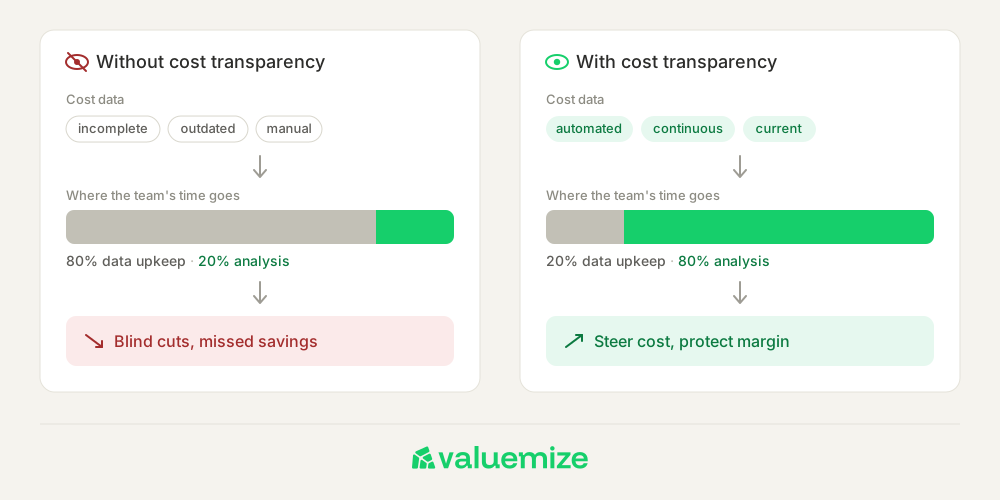
The shift is fundamental. Cost transparency doesn't have to be something your team produces by hand. It can and should be a layer the system maintains for you: automated, continuous, always current.
When the data maintains itself, the job inverts.
Reviews stop being quarterly events and turn into something closer to a live discussion. A design engineer can see what a change does to cost the moment they make it, not three weeks later in a report. The controller stops being a data janitor and goes back to being an analyst.
A good transparency layer makes a different ratio realistic: 80% of your cost team's time on analysis, not data management. Once the data exists as a maintained prerequisite, that split becomes the default and not an unachievable goal.
This matters most exactly where it's usually weakest: early. Most of a product's cost is committed in the first design decisions, long before anything is bought or built. That's the window where clear cost visibility is worth the most, and it's also the window where the data is thinnest, and thus people tend to make decisions based on their gut feeling. Fix transparency in that phase, and everything downstream gets easier.
If you recognize your own team in any of this, shift your focus away from another cost-cutting sprint. Start with a plainer question instead: how much of our cost picture is genuinely current, and available without someone rebuilding it by hand?
For most companies the honest answer is uncomfortable. But that's where the opportunity lies.
What if the cost review that takes your team six weeks ran on its own, in the background, every single day?
That's the layer we're building at valuemize: continuous product cost transparency your people steer instead of maintain, from the first design decision through the full life of the product.
If cost keeps landing on your desk as a data problem before it can become a decision, I'd like to show you how we can change that. Get in touch: https://www.valuemize.io/en/contact
#productcostmanagement #costexcellence #controlling #manufacturing #valuemize
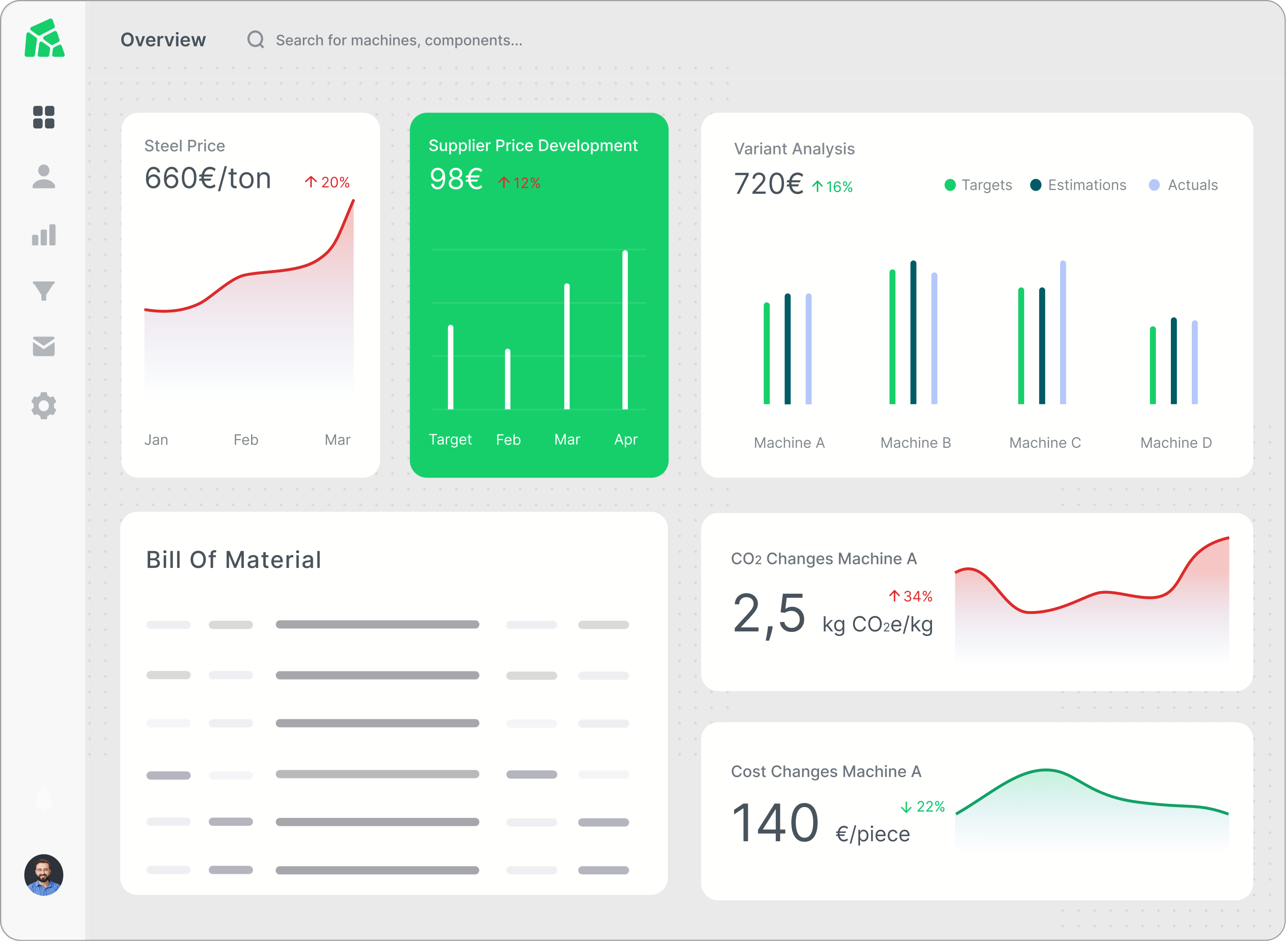
valuemize is a product lifecycle costing platform that helps industrial companies automate repetitive tasks, avoid & optimize costs, and enable cross-functional collaboration seamlessly.
© Copyright valuemize AG - 2026
Made with 💚 in Zurich & Munich
Follow us on