Hannes Gruber
July 20, 2026
You Can't Optimize What You Can't See
Cost transparency is the foundation every savings target sits on. In most companies, that foundation is missing.


Development costing is thorough. Production controlling is solid. What happens between them is where cost control quietly breaks down.

One pattern that keeps surfacing with our customers and the companies we are talking to is the handover problem. Development costing is thorough. Production controlling is solid. What happens between them is where cost control quietly breaks down.
Not with a big incident. Not in a board meeting. At the handover between development and serial production. Most companies don't notice until the variance reports arrive months later.
During product development, a cross-functional team puts serious effort into costing. Engineers design products, cost managers run calculations and build spreadsheets. Cost targets get set, reviewed, and signed off. On paper, the cost structure looks solid.
Then serial production starts.
A different team takes over. Different tools. Different assumptions about what the numbers mean. And critically: no shared memory of cost on a granular level, the underlying assumptions, or which cost drivers were considered acceptable and which were flagged as risks.
The knowledge gets lost in the handover.
Speaking with cost and value engineering leads across mid-cap and large industrial manufacturers, the same three failure points come up repeatedly.
ERP exports don't match the costing spreadsheets. Development costing happens in dedicated tools or spreadsheets. Production controlling happens in ERP. The two rarely speak to each other. Reconciling them is a manual, slow, and error-prone exercise, usually triggered only when a deviation is already significant.
Assumptions aren't documented. The cost target was built on certain material prices, make-or-buy decisions, and supplier quotes. By the time serial production is running, it's rarely possible to reconstruct the logic behind the original number. It just becomes "the target."
The question "why are we 15% above target?" takes weeks to answer. And by the time it's answered, the design is locked, the supplier contracts are signed, and the tooling has been paid for.
Across the 50+ companies we analyzed or worked with, almost none had a truly connected, automated product cost management process that truly ran end-to-end. Isolated pockets of excellence, yes. End-to-end continuity, rarely.
Cost deviations that originate in development don't announce themselves early. They accumulate quietly and only surface in production controlling when the variance reports come out. At that point, the options available to close the gap are expensive, slow, or both.
Late-stage tooling changes. Supplier renegotiations under time pressure. Cost-down programs that disrupt the production ramp. These are rarely edge cases. For many companies they're the standard response to a problem that was often visible earlier, if there had been the necessary transparency.
The companies that manage this best do not have better cost and value engineers. They have tighter integration between the two phases. Cost assumptions documented in development feed into production controlling. Deviations get flagged faster. The team responsible for production cost isn't starting from zero; they're inheriting a living record of what was planned and why.
The underlying issue is that development and production controlling are typically organized as separate functions, with different reporting lines, different KPIs, and different incentives. Development is measured on design milestones and technical targets. Production controlling is measured on variance against standard costs. Neither is measured on the quality of collaboration or the handover between them.
Process discipline helps. A structured cost handover package, a shared definition of cost targets, and a clear escalation path for deviations can close part of the gap. But there's a ceiling on what process alone can achieve when the underlying data lives in disconnected systems. At some point, the manual reconciliation between development costing and production controlling becomes the bottleneck.
What would it look like if both phases were connected in one system?
Not just data integration in the narrow technical sense. But a shared cost model that evolves continuously from first estimate through series production, where deviations are visible in real time, where the assumptions behind a target are accessible to the team running production, and where cost control isn't a quarterly reporting exercise but an ongoing signal.
That's the capability gap we built valuemize to close. Whether companies get there with dedicated tooling, a tighter ERP configuration, or something else, the direction is the same: cost transparency can't stop at the development gate.
The handover is where cost control breaks down. It's also where the biggest leverage is.
If this resonates with a challenge you're working through, I would be happy to learn more. Get in touch.
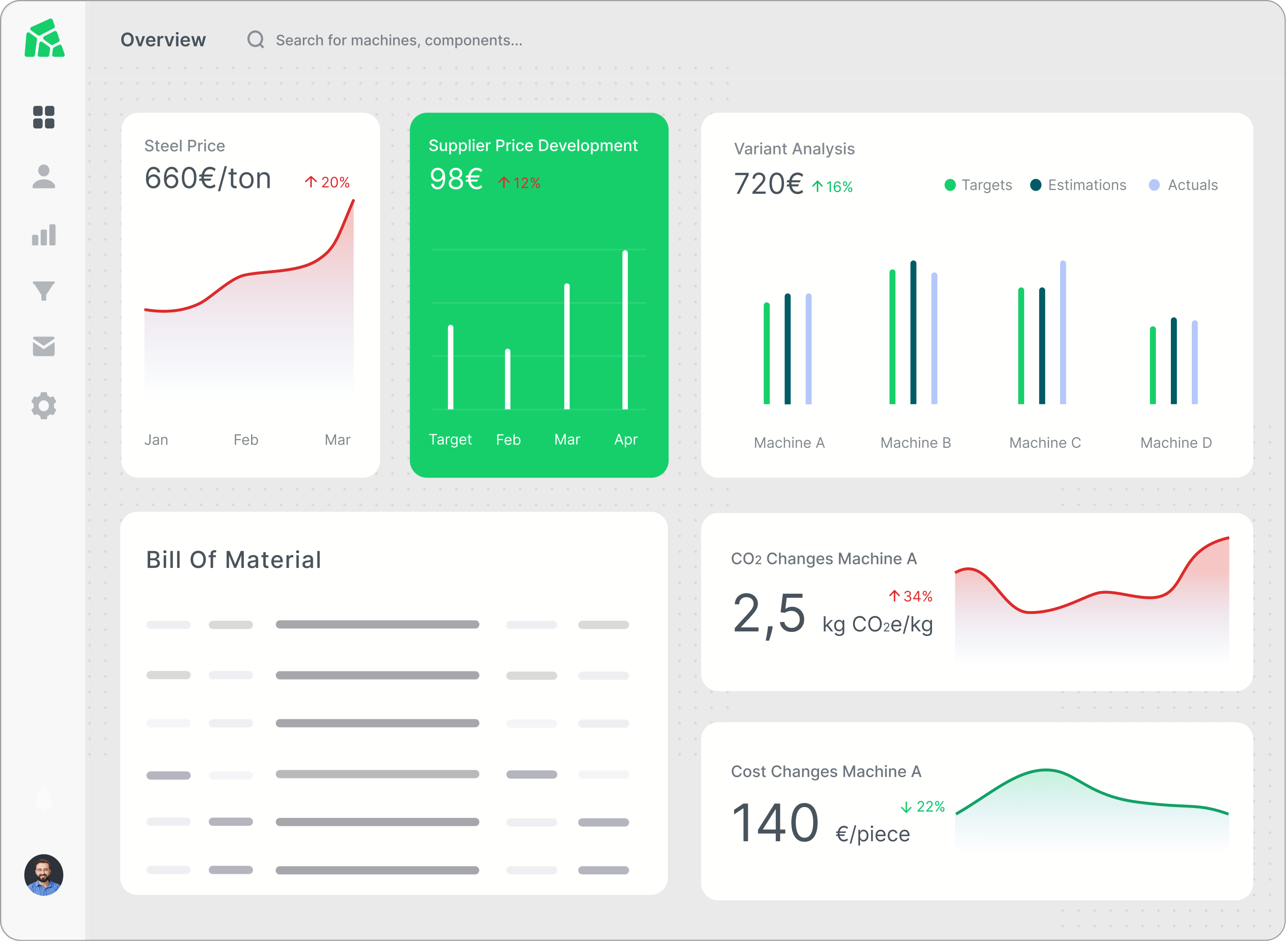
valuemize is a product lifecycle costing platform that helps industrial companies automate repetitive tasks, avoid & optimize costs, and enable cross-functional collaboration seamlessly.
© Copyright valuemize AG - 2026
Made with 💚 in Zurich & Munich
Follow us on