
Hannes Gruber
July 20, 2026
You Can't Optimize What You Can't See
Cost transparency is the foundation every savings target sits on. In most companies, that foundation is missing.


Why single-scenario thinking is one of the most common and most avoidable reasons products overshoot their cost targets
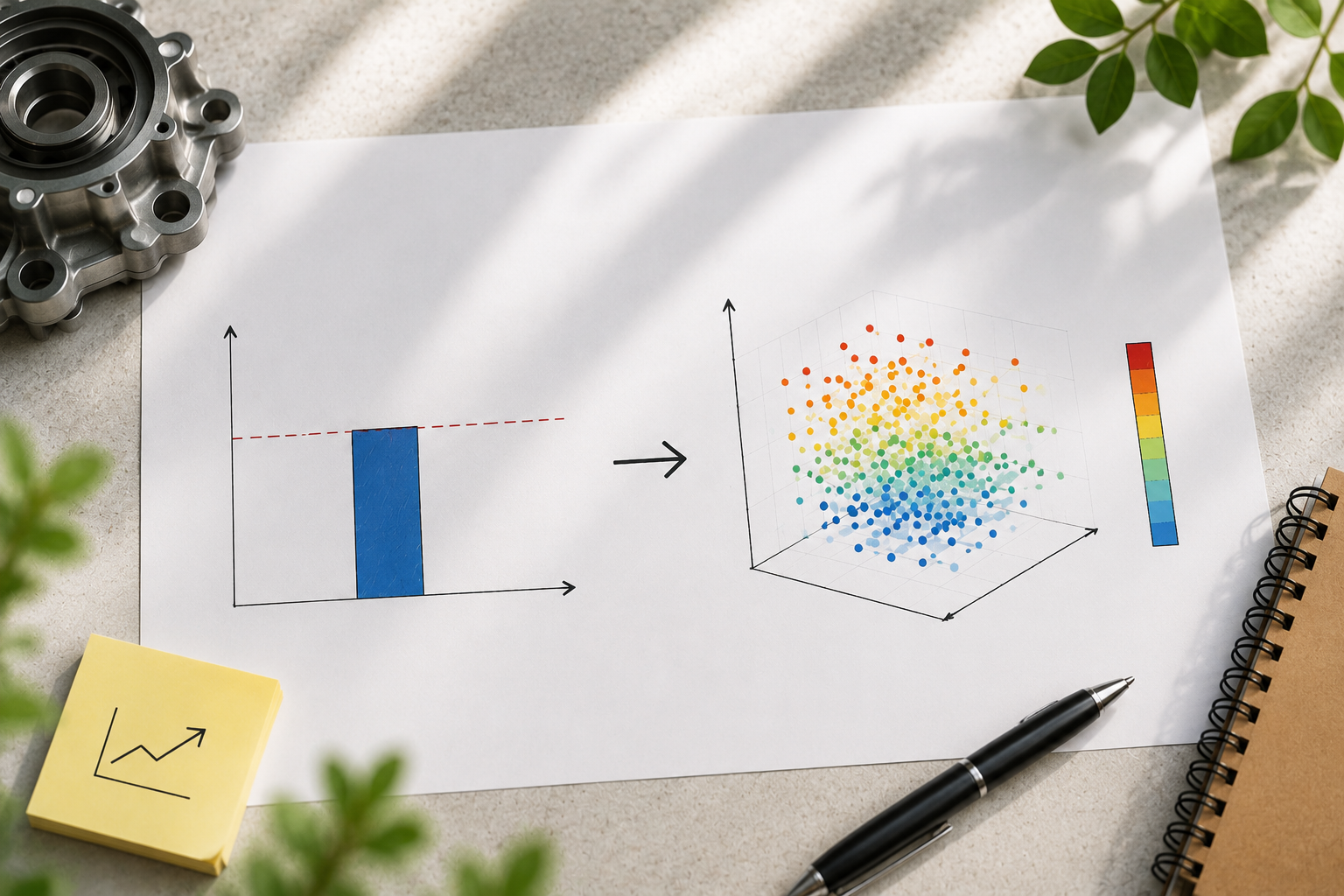
Why single-scenario thinking is one of the most common and most avoidable reasons products overshoot their cost targets
It comes up in many conversation we have with manufacturing leaders.
Not occasionally. Not in companies that are struggling otherwise. In well-run businesses with experienced teams, structured development processes, and clear commercial pressure to hit cost targets. The target gets set. And somewhere between concept and series production, the gap opens.
When we dig into why, the answer is rarely a single failure. It's a system set up to miss.
Targets defined without a clear methodology. Simulations built on the optimistic scenario. Procurement, engineering, and controlling each working from different data. By the time someone reconciles the numbers, the design decisions are already locked and the cost is already fixed.
Each of these failures is recoverable on its own. All of them together, and you have a cost program that was unlikely to succeed before it started.
This article is about one of the most common, most avoidable of these root causes: the single-scenario simulation. Why it fails, what it misses, and what changes when you replace it with something more robust.
Most cost simulations share the same structural problem. They are built to answer one question: what does this product cost if everything goes according to plan?
That's a useful question. It's just not the only one that matters.
The plan is a snapshot. A single point in time, built from a single assumption set. One supplier price. One exchange rate. One production volume. One set of process parameters. Everything locked together into a number that gets handed to leadership, written into a business case, and used to set a target that the organization is then measured against for the next three to five years.
The problem is not that teams are lazy or imprecise. Most simulations are technically careful. The engineers know their materials. Procurement has the supplier quotes. The calculation is correct for the assumptions it was built on.
The problem is that the assumptions turn wrong before the project ends.
Supplier prices shift. Volumes change. Exchange rates move. Ramp-up curves take longer than planned. A component substitution late in development changes the processing cost. A regulatory requirement adds a step. The project delivers something close to the product that was simulated, but not in the volume, at the time, or under the conditions that the calculation assumed.
And no one saw it coming, because no one looked.
Of all the variables that drive product cost, volume is the one companies are most likely to treat as fixed.
This is a significant error.
Product costs are not linear. They don't halve when volume doubles, and they don't stay flat when volume drops by 30%. The relationship between volume and unit cost is far more complex.
A product simulated at 8,000 units per year might look profitable. The same product at 5,500 units, with a supplier contract that assumed the higher volume, might not be. The gap between those two outcomes is not a rounding error. It can be the difference between a project that returns its investment and one that quietly drains margin for its entire lifecycle.
Most teams know this. What they don't do is simulate it.
The typical output of a cost simulation is a single number, or at best a range built from two scenarios: base case and worst case. Both are usually constructed by adjusting one variable at a time, which misses the compounding effect of multiple assumptions moving together. Volumes come in lower, at the same time that material prices rise, at the same time that the ramp up takes six months longer than planned. The scenarios that actually occur are almost never the ones that were modeled.
Systematic scenario and sensitivity analysis is not a new concept. In project finance and investment management, stress-testing against multiple variable combinations is standard practice. In product cost management, not many companies do it properly.
The structure of a sound simulation approach has three elements.
A defined variable set. Before any number is calculated, the team identifies the variables that carry the the most uncertainty and the highest leverage. Volume is always on this list. So are key raw material prices, exchange rates for cross-border supply chains and process efficiency assumptions for new or unfamiliar manufacturing steps. The list is not exhaustive. It is a deliberate selection of the variables that, if wrong, would change the business case.
A range for each variable, not a point estimate. For each variable in the set, the team defines a realistic low case, a base case, and a high case. These ranges should be informed by market data, supplier input, and historical variance on similar projects. A volume range of plus or minus 20% from plan is not conservative. It is often the actual spread on project that run longer than three years.
A systematic combination of scenarios. With a variable set and ranges defined, the team runs a structured set of scenario combinations. The goal is not to cover every possible outcome. It is to identify the combinations of conditions that would push the product into unprofitability, and to understand how likely those combinations are. The output is not one number. It is a cost distribution that shows where the risk is concentrated and which variables drive it.
While this takes more effort than a single-point simulation, it also produces information that is actually useful for decision-making.
The question is not "what does this cost?" The question is "under what conditions does this cost become a problem, and what can we do about it before we get there?"
The practical impact of systematic scenario analysis is not primarily in the numbers. It is in the decisions.
When a team can see, before a design is locked, that a 25% volume reduction pushes the product below its cost target, they can make different choices. They can negotiate volume flexibility into supplier contracts. They can optimize the design for a lower volume scenario. They can adjust the target itself, and have an honest conversation with the business about what is achievable under different market conditions.
None of these conversations are easy. All of them are easier early than late.
A team running a well-structured simulation is not trying to predict the future. They are mapping the terrain. They know which combinations of conditions create risk, where the cost structure has flexibility, and where it doesn't. When conditions change, as they always do, they are not surprised. They are prepared.
The gap between plan and actual does not close by accident. It closes when the plan was built with enough range to reflect how the world actually behaves.
There is a reason systematic scenario analysis is not standard practice in product cost management. It is hard to do in Excel.
Running a structured multi-variable simulation requires a data foundation that is live, shared, and connected. Supplier prices that update when quotes change. Volume assumptions that flow through to all cost layers simultaneously. A calculation engine that can run dozens of scenario combinations without someone manually rebuilding the model each time.
Most cost teams are operating without this infrastructure. Their simulations are point-in-time because building anything more dynamic takes more time than the team has. They know the methodology is narrow. They don't have a practical alternative.
This is the problem we built valuemize to solve. A shared data foundation that connects procurement, engineering, and controlling on one platform, with scenario and sensitivity analysis built into the calculation engine. So teams can run the right simulations, not just the fast ones, and see how their cost structure behaves across the full range of conditions that actually matter.
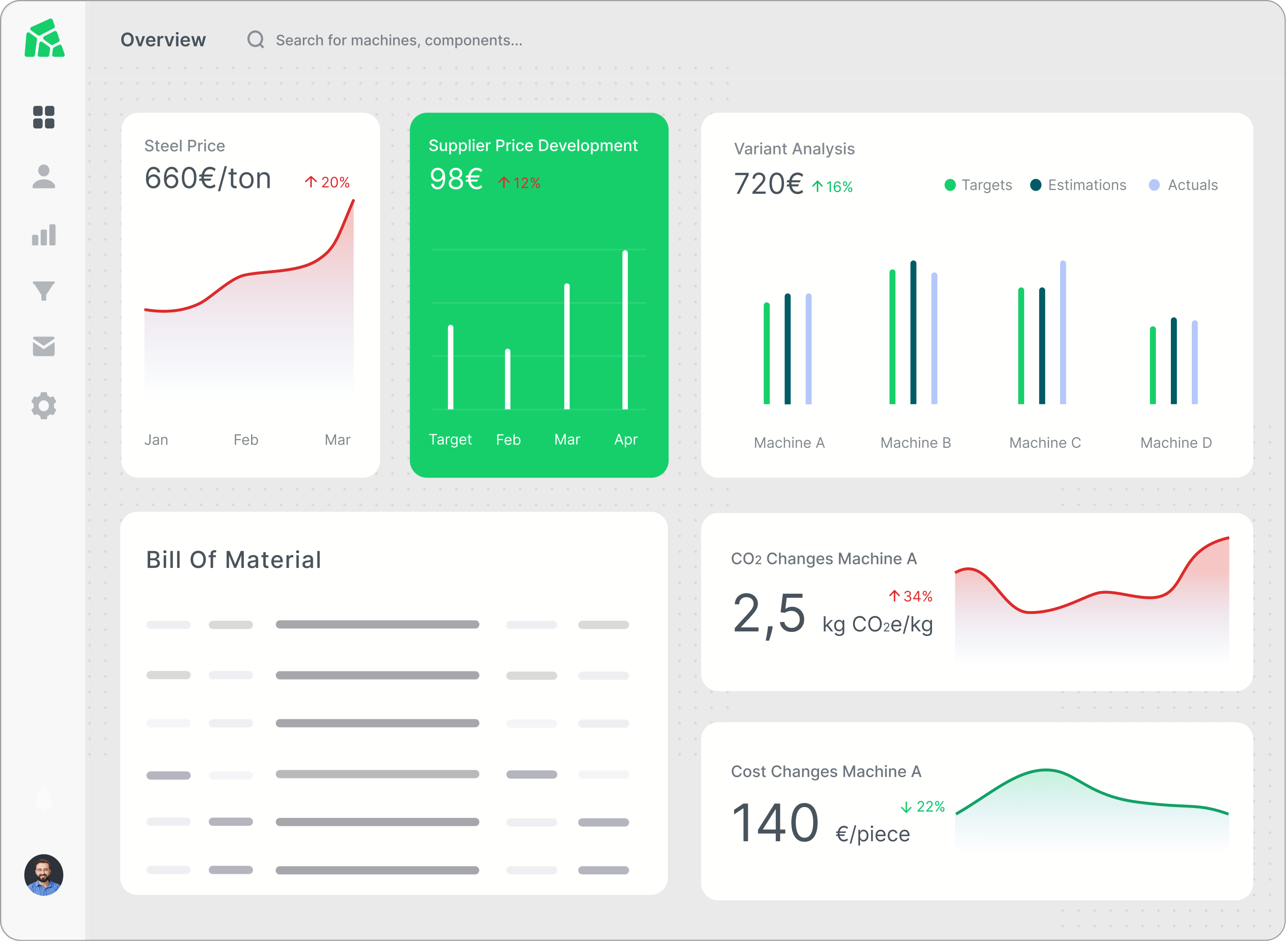
valuemize is a product lifecycle costing platform that helps industrial companies automate repetitive tasks, avoid & optimize costs, and enable cross-functional collaboration seamlessly.
© Copyright valuemize AG - 2026
Made with 💚 in Zurich & Munich
Follow us on


