Hannes Gruber
July 20, 2026
You Can't Optimize What You Can't See
Cost transparency is the foundation every savings target sits on. In most companies, that foundation is missing.


Most product companies don't manage costs. They react to them. Here's what the discipline actually looks like, why so few companies practice it, and what it costs the ones that don't.
I spent more than five years in product cost engineering and global value creation roles at INNIO, ABB, and Accelleron. Each time, the same picture kept surfacing from the inside: cost managers buried in Excel, cost reviews running on numbers that were already weeks old, cost-down projects launching when the design was already locked.I assumed for a long time that this was a function of the specific companies, or the specific programs, or the specific timing. Big organizations, complex products, legacy systems. Of course it's hard.
When we founded valuemize, we started talking to other companies. In more than 90 conversations, with cost managers, controllers, and product development leads across machinery, automotive supply, and industrial equipment, it became clear, that the pattern wasn't specific to any of those companies. It is the industry standard.Most companies don't manage product costs. They react to them.
Not because the people aren't capable. They are. The reason is, that the practice is missing. There is no recurring cycle, no clear targets, no structured way of moving from "we have a cost problem" to "we know what to do about it." What exists instead is firefighting. Quarterly cost-down initiatives launched when the design is already locked. A controller chasing the BOM three weeks after it changed. A cost engineer rebuilding the same Excel model for the fourth time this year because the last version drifted out of sync with reality.
This isn't a tooling problem, though tools play a role. It's a discipline problem. And the discipline has a name: strategic product cost management.
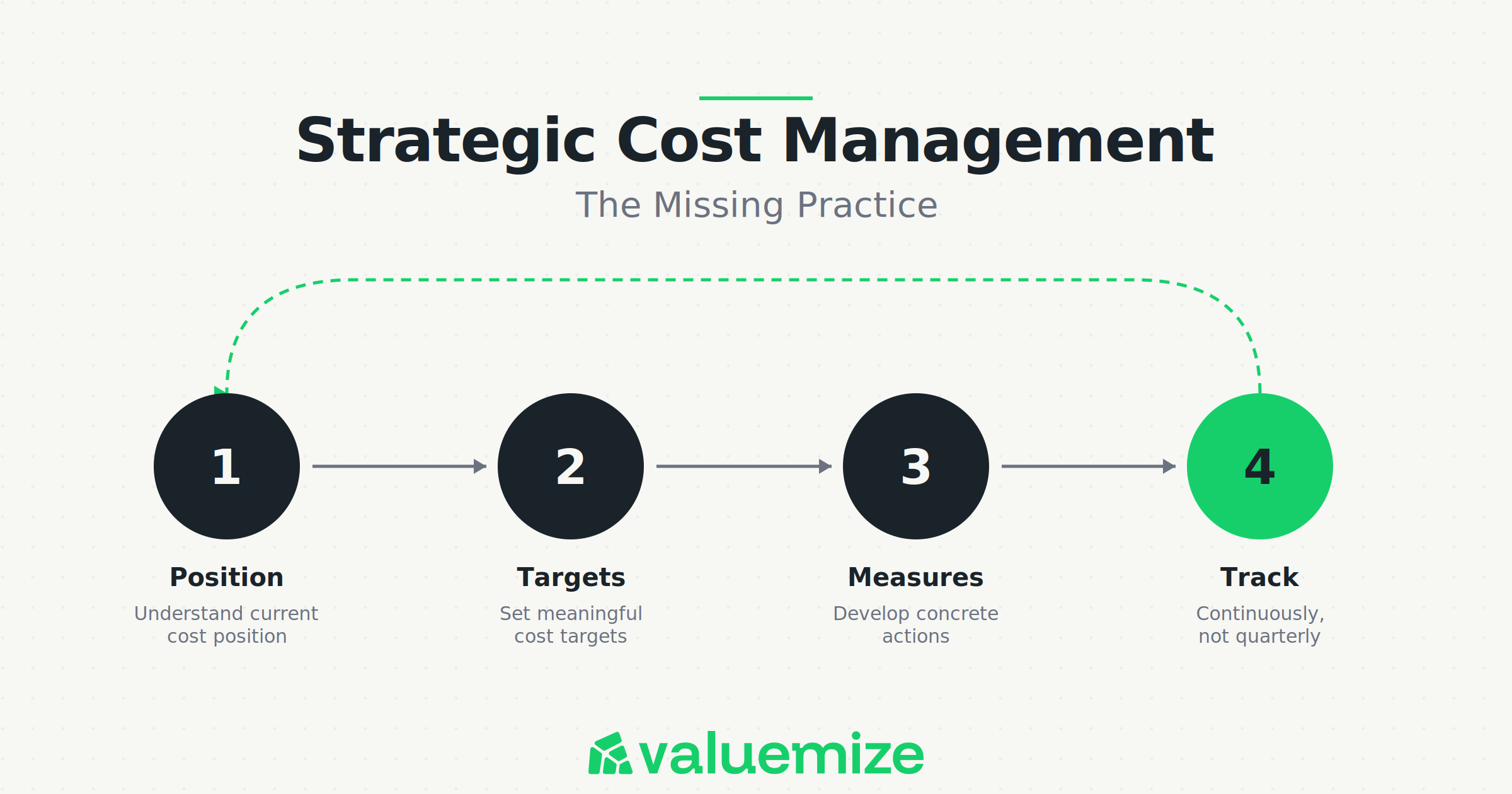
Strategic product cost management isn't a one-time project. It's a recurring cycle, run continuously, with four steps:
None of these four steps is exotic. Most cost managers can describe them. The problem is that almost no company runs the full cycle end-to-end. They run pieces of it, in disconnected silos, on different cadences, with different versions of the truth.
The honest answer is that the manual effort required to create transparency is too high.
Step 1 alone, understanding the current cost position, can consume eighty percent of a cost manager's calendar in any given month. Pulling material costs from the ERP, current BOM structures from the PLM, the latest design revisions from CAD, supplier prices from a spreadsheet that lives somewhere on a shared drive, labor and overhead allocations from finance. Reconciling all of it. Finding the version where the totals actually match. Discovering that they don't, and starting over.
By the time the data is current, two things have happened. The window to set meaningful targets has narrowed, because product decisions have already been made on assumptions nobody verified. And the cost manager has spent a month doing data administration instead of cost work.
Step 4 is where the cycle dies most often. Tracking results requires a system that updates automatically as the BOM changes, as suppliers re-quote, as design revisions land. Without that, "tracking" becomes a manual reconciliation exercise that nobody has time for. So it doesn't happen. So nobody knows whether the cost-down initiative actually delivered. So next year, the same people launch the same kind of initiative, with the same targets, and the same lack of follow-through.
This is the trap. The cycle requires transparency. Transparency requires effort. The effort is so high that companies skip the cycle. So the cycle never produces the transparency that would have made it sustainable in the first place.
Consider a mid-cap machinery company. €280M revenue, eight product families, around 12,000 active SKUs. Cost engineering is a team of four, sitting between Engineering, Sourcing, and Finance. They are good at their jobs.
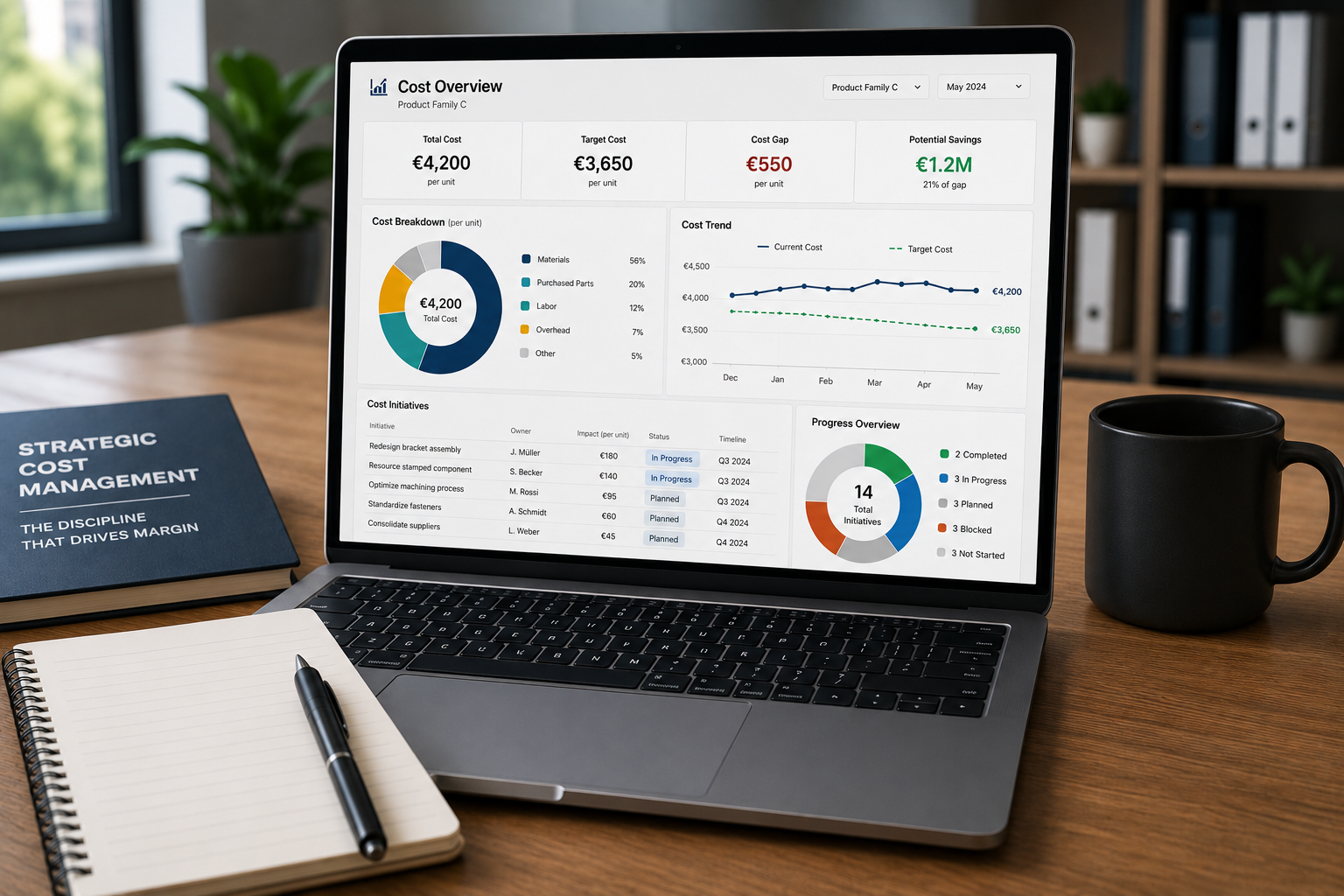
In Q1, the company launches a cost-down initiative on Product Family C, a workhorse line that's been on the market for six years. Margin has slipped from 15% to 8% over that period. Leadership wants 4 percentage points back.
The cost engineering team starts where they always start: rebuilding a current cost picture. The PLM has been migrated twice since the product was launched. The original cost model lives in an Excel workbook the engineer who built it took with him when he left in 2022. Three weeks of work to reconstruct a baseline.
The team then identifies fourteen cost initiatives, ranging from a redesign of one bracket assembly to a re-sourcing of a stamped component. Twelve of the fourteen require Engineering hours. Engineering is fully loaded on the next-generation product launch and has no capacity until Q3. The two initiatives that don't require Engineering are sourcing-only re-quotes, expected to save 1.2 percentage points combined.
Six months in, the team is tracking results in a spreadsheet that gets updated when someone remembers to update it. Two of the fourteen initiatives have closed. Three are blocked. The rest are unclear. By Q4, the leadership conversation has moved on to a different topic, and the cost-down initiative quietly fades.
What did this cost the company?
Direct: the four percentage points of margin recovery never materialized. On Product Family C's annual revenue of roughly €70M, that's €2.8M of margin not recovered. Year after year.
Indirect: four cost engineers spent the better part of a year on an initiative that delivered 1.2 percentage points instead of four. The other 2.8 points were not unrecoverable. They were just unrecoverable with the available transparency.
Compounding: this is Product Family C. The company has seven other families, all aging on the same trajectory. The same pattern is in motion across all of them. Nobody has time to look.
This is a composite, but based on our experience from valuemize. The pattern shows up in roughly the same shape across most companies that haven't yet built the strategic cost management practice.
Companies that do run the cycle end-to-end share a few characteristics. They tend to be the exception, not the rule, but they exist, and what they do is learnable.
They treat cost transparency as infrastructure, not a deliverable. The current cost position is always available, not assembled on demand. When someone asks "what does Product C actually cost us today," the answer is one screen away, not three weeks of reconciliation away.
They set targets at component or sub-system level, not just product level. "Save 10% on Product C" is a wish. "Reduce the cost of the drive assembly from €4,200 to €3,650 by Q3 through three specific changes" is a plan.
They run a recurring cost forum, not occasional initiatives. A monthly meeting where the same people review the same dashboard, ask the same questions, and decide on the next moves. The forum exists because the data exists to support it. The forum reinforces the value of keeping the data current.
They measure cost engineering by cost outcomes, not by reports produced. This is a cultural change as much as a process one. When a cost engineer spends 80% of their time analyzing and acting and 20% on data administration, the role looks completely different than the inverse.
The shift from the typical 80/20 inverted to the right way around is the single biggest lever a cost organization has. Not because cost engineers are inefficient. Because the manual data work fills whatever time is available and crowds out the work that actually moves margin.
Strategic cost management as a discipline predates any software. The cycle, the targets, the forums, the measurement, all of this can be done with paper and a determined team. The question is whether it can be done at scale, sustainably, in companies with thousands of components and dozens of products.
The honest answer from practice is: rarely.
This is where software comes into play. It serves as the infrastructure that makes the discipline practical. When BOM changes flow into the cost model automatically and supplier price updates land in the right place without much copy-work, the cost manager can open the dashboard on Monday morning and sees what changed last week. With the impact already calculated. The for fetched aspirations become a realistic goal.
This is the gap we built valuemize to close. Not by replacing the cost engineer's judgment, which is the part that actually matters. By eliminating the manual data work that prevents that judgment from being applied to anything important.
Companies looking to build the practice don't usually fail at understanding what to do. They fail at the first step: getting transparency into the current cost position without burning a quarter to do it. Everything else, the targets, the measures, the tracking, follows from that foundation.
If you're inside a cost organization that is spending most of its time on data work, the question worth asking isn't "how do we cut more costs." It's "how do we get our cost engineers back the time they need to actually do cost engineering."
That's the real practice that's missing. And it's the one that, when present, makes every other cost initiative work.
If you're navigating this in your own organization and want to compare notes on how it's playing out elsewhere, get in touch: Book a Meeting
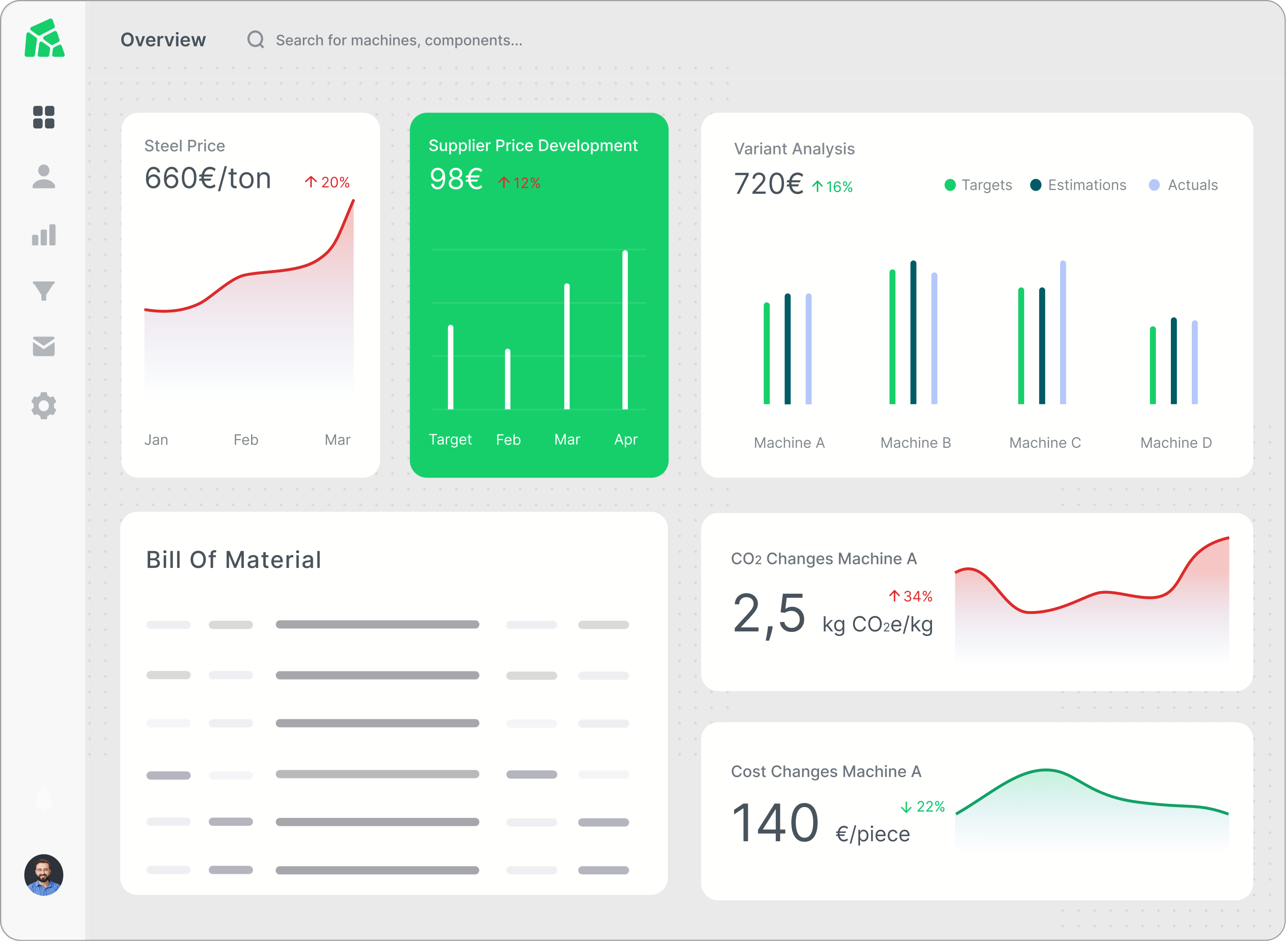
valuemize is a product lifecycle costing platform that helps industrial companies automate repetitive tasks, avoid & optimize costs, and enable cross-functional collaboration seamlessly.
© Copyright valuemize AG - 2026
Made with 💚 in Zurich & Munich
Follow us on